

Description
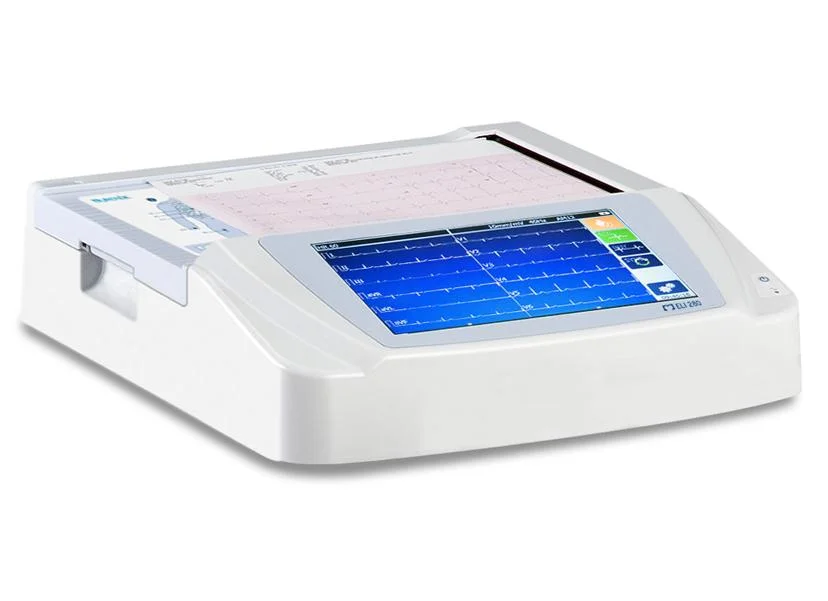
Burdick 280 EKG Machine
This listing is for a fully refurbished unit with accessories and a 1yr warranty. The unit would arrive “patient ready”
Summary
The Burdick ELI 280 (12-lead resting ECG) represents a feature-rich, clinically advanced ECG system suited to high‐volume environments in both hospital and outpatient settings. With its large touchscreen display, advanced signal fidelity, automated Best10 quality capture, wireless/ wired acquisition flexibility, network connectivity, and interpretive algorithm, it offers a strong workflow and clinical offering. For organizations needing quality ECG diagnostics with integration into digital health systems, this unit stands out.
Physical & Hardware Specifications
Display & User Interface
-
It features a 10.1” high-resolution colour touchscreen LCD for display of up to 12 leads simultaneously.
-
The screen layout is “widescreen” to permit full-lead display, menu navigation, fast patient data entry and clear verification of electrode connections.
Size, Weight, and Portability
-
One source gives the device weight as 12.5 lbs (5.68 kg) including battery (without paper).
-
Dimensions given: 17.5 × 15.5 × 4.5 inches (≈ 44.45 × 39.37 × 11.43 cm) in one spec sheet.
-
The device includes an internal rechargeable battery (in addition to universal AC power supply) in many configurations.
Printing & Storage
-
Thermal printer included: options for paper perforated Z-fold, either A4 or 8.5 × 11″ wide; printer speeds 5, 10, 25, or 50 mm/s; gain settings 5, 10, or 20 mm/mV.
-
Internal storage: up to 200 ECGs in memory in certain configurations.
Performance / Signal Acquisition Details
-
A/D conversion: 20 bits resolution (≈ 1.17 µV LSB) in one spec sheet.
-
Frequency response: 0.05 to 300 Hz; filters include high-performance baseline filter, AC interference filter (50/60 Hz), low-pass filters at 40 Hz, 150 Hz or 300 Hz.
-
Digital sampling: The spec sheet lists 40,000 samples/second/channel for pacemaker spike detection and 1,000 samples/second/channel for recording/analysis.
-
Input impedance, electrode offset tolerance, common-mode rejection, patient leakage / chassis leakage meet ANSI/AAMI standards (e.g., EC11, ES1) in one spec sheet.
ECG Acquisition & Processing Capabilities
-
The system supports full 12-lead resting ECG acquisition.
-
The “Best 10” feature: The device evaluates signal quality/noise and selects the best contiguous 10 second interval from up to 5 minutes of acquired data, reducing need for repeat ECGs due to artifact.
-
Hook-up verification and lead reversal detection: The system detects lead reversals (claim: up to 80% of lead reversals can be detected with a false positive rate of 1.4%).
-
Pacemaker spike detection supported (enabled by high sampling) for reliable capture of pacing spikes.
-
The print formats: options include 12-lead print (10 s of 12 leads), 3+1 (2.5 s of 12 leads in 3-channel format + 10 s rhythm strip of 1 lead), 3+3, 6, 6+6.
Workflow, Connectivity & Integration
-
Connectivity: Offers network connectivity for EMR/EHR, PACS or CVIS integration. Several sources mention USB, LAN, 802.11 wireless options.
-
Acquisition module choice: Either the wireless acquisition module (WAM) or a wired acquisition module (AM12). Both include replaceable lead wires, lead fail indicator, and remote control buttons for ECG acquisition and rhythm printing.
-
Data security: Supports device access controls, LDAP/Active Directory integration, encryption at rest and in transit for ePHI.
-
Designed for high‐volume ECG workflows: The large screen, quick patient data entry, and full-lead verification aim to reduce repeat studies and increase througut.
Interpretive / Clinical Algorithm Capabilities
-
The device includes (or optionally can include) the VERITAS® resting ECG interpretation algorithm (from Mortara) which uses gender-specific, adult and pediatric criteria to provide a preliminary interpretation (to be confirmed by a clinician).
-
Hook-up confirmation and detection of lead reversals are part of the interpretive workflow.
-
The high sampling rate (40,000 sps/channel) supports accurate pacemaker spike detection, which is clinically relevant for patients with pacing devices.
Usability, Maintenance & Other System Aspects
-
The touchscreen UI and full-lead display make it more intuitive for operators and reduce risk of mis-lead placement or misinterpretation.
-
The replaceable lead wires and modular acquisition options increase serviceability.
-
Thermal printing and internal ECG storage allow for on-site review and archiving; however, facilities may still need to manage paper supply, storage space for printed ECGs, and digital export.
-
Because of network integration and data encryption features, it is suitable for facilities needing to comply with data security / HIPAA / ePHI requirements.
-
Maintenance: As with any diagnostic ECG system, calibration, lead wire integrity checks, electrode compatibility, and compliance with safety standards (e.g., ANSI/AAMI) remain important. The user manual emphasises safety, correct AC power connection (hospital grade outlet), and patient isolation distances.
Strengths & Potential Limitations
Strengths
-
Versatility and workflow optimization: The Best 10 feature, large touchscreen, full 12-lead display, and lead-verification features help reduce repeats and operator error.
-
Flexible acquisition: Wired or wireless options allow adaptation to bedside, portable or isolation settings.
-
Solid connectivity/integration: Designed for modern networked workflow, EMR/EHR integration, and supports data security features.
-
High technical signal fidelity: High sampling rate, broad frequency response, 20-bit A/D contribute to accurate ECG signal capture (including pacemaker spikes).
-
Recognised interpretive algorithm: The VERITAS algorithm adds clinical decision support (though always confirmed by clinician).
-
Proven product lineage: From Mortara/Burdick/Welch Allyn heritage, meaning good service network and known track record.
Potential Limitations / Considerations
-
As a feature-rich ECG machine, cost is higher than basic ECG units; specifications sest mid/high end pricing.
-
The device weight (12.5 lb) is moderate for portability but not ultra-light.
-
While 200 ECG storage is adequate for most practices, larger facilities may need bigger archival solutions or network digital storage.
-
Wireless acquisition module adds freedom but also complexity (battery life, wireless reliability, troubleshooting) relative to fully wired units.
-
As with all automated interpretation, the algorithm is a preliminary tool and must be reviewed by a trained clinician; over-reliance may lead to errors if not used correctly.
Background and Positioning
-
The device is branded as the ELI 280 Resting Electrocardiograph and is part of the cardiology-diagnostic portfolio of Hillrom (formerly Welch Allyn / Mortara / Burdick) under the parent company Baxter International.
-
It is targeted at facilities requiring high-volume ECG workflows, from physician offices to hospital acute care settings..
-
It supports both wired and wireless acquisition modules, making it versatile for bedside, isolation, or mobile use.
-
In short: a mature, feature-rich 12-lead resting ECG system designed for clinical/diagnostic print, storage, and network integration.